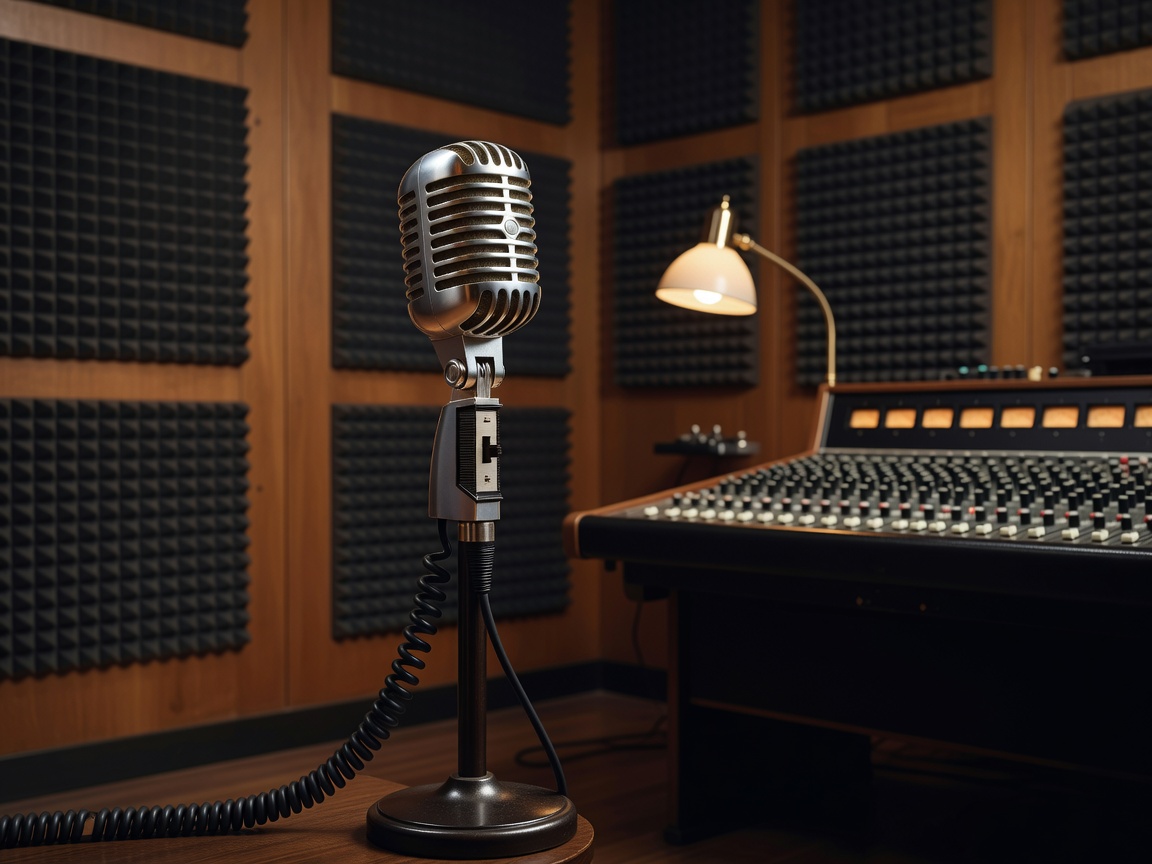
Before condenser microphones dominated the modern studio, the golden era of broadcasting and early recording was captured through ribbon microphones. Known for their unmistakably smooth, dark, and natural sound reproduction, ribbon microphones are a specialized sub-category of dynamic microphones that every audio engineer eventually learns to revere.
The Velocity Principle
Technically, a ribbon microphone operates on the same fundamental principle as a moving-coil dynamic mic: electromagnetic induction. However, instead of a plastic diaphragm attached to a coil of wire, a ribbon mic utilizes an extremely thin strip of corrugated aluminum (often only a few microns thick) suspended directly between the poles of a powerful magnet.
This aluminum ribbon serves as both the diaphragm and the electrical transducer. As sound waves hit the ribbon, it moves within the magnetic field, generating a tiny voltage. Because the ribbon is so light—often lighter than the air molecules pushing against it—it responds to the velocity of the air particles rather than just the pressure variations, giving it an incredibly accurate transient response akin to a condenser microphone.
The Figure-8 Polar Pattern
By physical design, the aluminum ribbon is open to the air on both its front and back sides, but blocked by the magnets on its sides. This natively creates a bidirectional, or "Figure-8," polar pattern. The microphone will pick up sound perfectly from the front and the back, but will completely reject sound arriving from the 90-degree sides (the null points).
This deep rejection at the sides makes ribbon microphones incredibly useful in ensemble recordings. You can place a ribbon mic between two instrumentalists and angle the null point toward an unwanted noise source, achieving massive acoustic isolation even in a single room.
The Ribbon Sound
The primary reason engineers seek out ribbon microphones is their frequency response. Condensers often have a resonant peak in the upper frequencies that can make them sound harsh or sibilant on certain sources. Ribbons, conversely, have a very smooth, natural high-frequency roll-off. They capture sound exactly as the human ear hears it in the room.
This makes them the absolute go-to choice for taming harsh, strident instruments. A screeching violin, a blaring trumpet, or a heavily distorted electric guitar amplifier can sound piercing through a condenser, but a ribbon microphone will smooth out the abrasive top-end, delivering a thick, creamy, and warm tone. Furthermore, ribbon mics take equalization (EQ) better than almost any other microphone. You can boost the high-end of a ribbon recording aggressively in the mix without it ever sounding brittle or electronic.
Extreme Fragility
The magic of the ribbon microphone comes at a severe cost: fragility. The corrugated aluminum ribbon is one of the most delicate mechanisms used in modern audio.
- Air Blasts: A strong gust of wind, blowing into the microphone, or placing it in front of a kick drum port can instantly stretch or tear the ribbon, requiring an expensive factory repair.
- Phantom Power Danger: With vintage passive ribbon microphones, accidentally applying 48V phantom power on a miswired cable can send a jolt of electricity through the ribbon, violently snapping it out of its magnetic gap. (Note: Modern active ribbon microphones actually require phantom power to run their internal preamps, but passive ribbons must be protected).
- Storage: Ribbon microphones should ideally be stored vertically. If left horizontally for long periods, gravity can cause the ultra-thin ribbon to sag, altering its tension and degrading its frequency response.
| Specification | Typical Ribbon Profile |
|---|---|
| Transducer Principle | Electromagnetic (Aluminum Ribbon) |
| Polar Pattern | Naturally Bidirectional (Figure-8) |
| High-Frequency Response | Smooth roll-off (darker, warmer sound) |
| Output Level | Very low (requires high-gain preamp) |
Despite their delicate nature and low output levels, the sonic reward of a ribbon microphone is undeniable. They are an essential tool for providing contrast in a digital recording world that is often overly bright and clinically sterile.