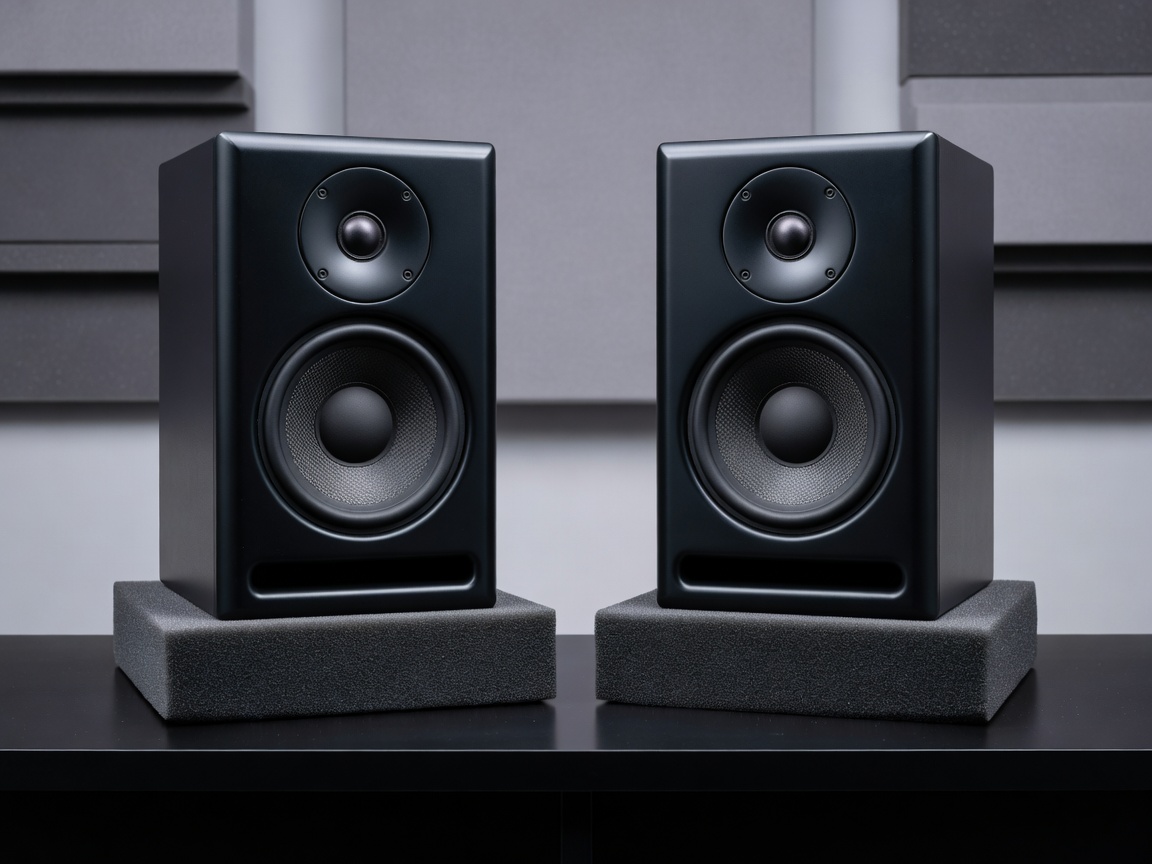
A mix is only as good as what the engineer can actually hear. While consumer hi-fi speakers are designed to make music sound pleasant, studio monitors are designed to reveal the brutal truth. Understanding the difference between recreational listening equipment and professional monitoring is crucial for producing audio that translates well across all playback systems.
Flat Frequency Response
Consumer speakers frequently feature a "smiley face" EQ curve: they artificially boost the bass to make the audio sound more powerful, and boost the treble to add perceived clarity. If an engineer attempts to mix on these speakers, they will naturally cut the bass and treble in their mix to compensate. When that mix is played on a standard car stereo, it will sound hopelessly thin and dull.
Studio monitors are engineered for a flat frequency response. They are designed to reproduce every frequency across the human hearing spectrum at an equal volume level. They do not flatter the sound; if a recording has a muddy lower-midrange, a good studio monitor will expose that muddiness aggressively, forcing the engineer to correct the problem at the source.
Active vs. Passive Systems
Historically, studio monitors were passive systems, meaning they required a standalone, external power amplifier to drive the speaker cones. Today, the vast majority of professional studio monitors are active.
An active monitor houses its own power amplifiers internally. More importantly, high-quality active monitors utilize a bi-amplification system. A built-in active crossover splits the incoming audio signal into low and high frequencies before amplification. One dedicated amplifier powers the woofer (lows), and a separate dedicated amplifier powers the tweeter (highs). This prevents heavy bass transients from stealing power from the high-frequency reproduction, leading to massive improvements in clarity and transient response.
Nearfield vs. Midfield
Monitor selection is entirely dependent on the acoustic space they will inhabit.
- Nearfield Monitors: Designed to be positioned close to the listener's ears (typically 3 to 5 feet away). By sitting close to the speakers, the ratio of direct sound (from the speaker) to reflected sound (bouncing off the walls) is maximized. This minimizes the negative impact of an untreated room. Nearfields are the standard for modern home and project studios.
- Midfield / Main Monitors: Large, extremely powerful speakers built flush into the walls of world-class studio control rooms. They are capable of reproducing sub-bass frequencies at club-level volumes. Because they are further away from the listener, the room must be meticulously acoustically treated to prevent echoes and standing waves from destroying the accuracy of the sound.
Placement and Acoustics
Even a $10,000 pair of studio monitors will sound terrible in a poorly treated room. Sound waves bouncing off hard walls create comb filtering and standing waves—phenomena where certain frequencies cancel each other out (creating dead zones) while others build up (creating resonant peaks).
Proper setup requires forming an equilateral triangle between the two monitors and the listener's head. The tweeters should be exactly at ear level. Furthermore, acoustic treatment in the form of high-density fiberglass bass traps in the room corners, and broadband absorbers at the "first reflection points" on the side walls, is mandatory for critical monitoring.
| Specification | Importance |
|---|---|
| Frequency Range | Wider is better, but true flat response is more important than extreme bass extension. |
| Crossover Frequency | The point where audio splits between woofer and tweeter; a smooth transition is vital for vocal clarity. |
| Porting | Front-ported or sealed designs are generally easier to place near walls than rear-ported designs. |
Ultimately, a studio monitor is a diagnostic tool. By investing in accurate playback systems and proper acoustic treatment, engineers strip away the illusions of consumer audio and gain the clinical insight required to craft professional mixes.